
Why Sunspot's Dunn Solar Telescope Is Being Demolished
Published 4 October 2026
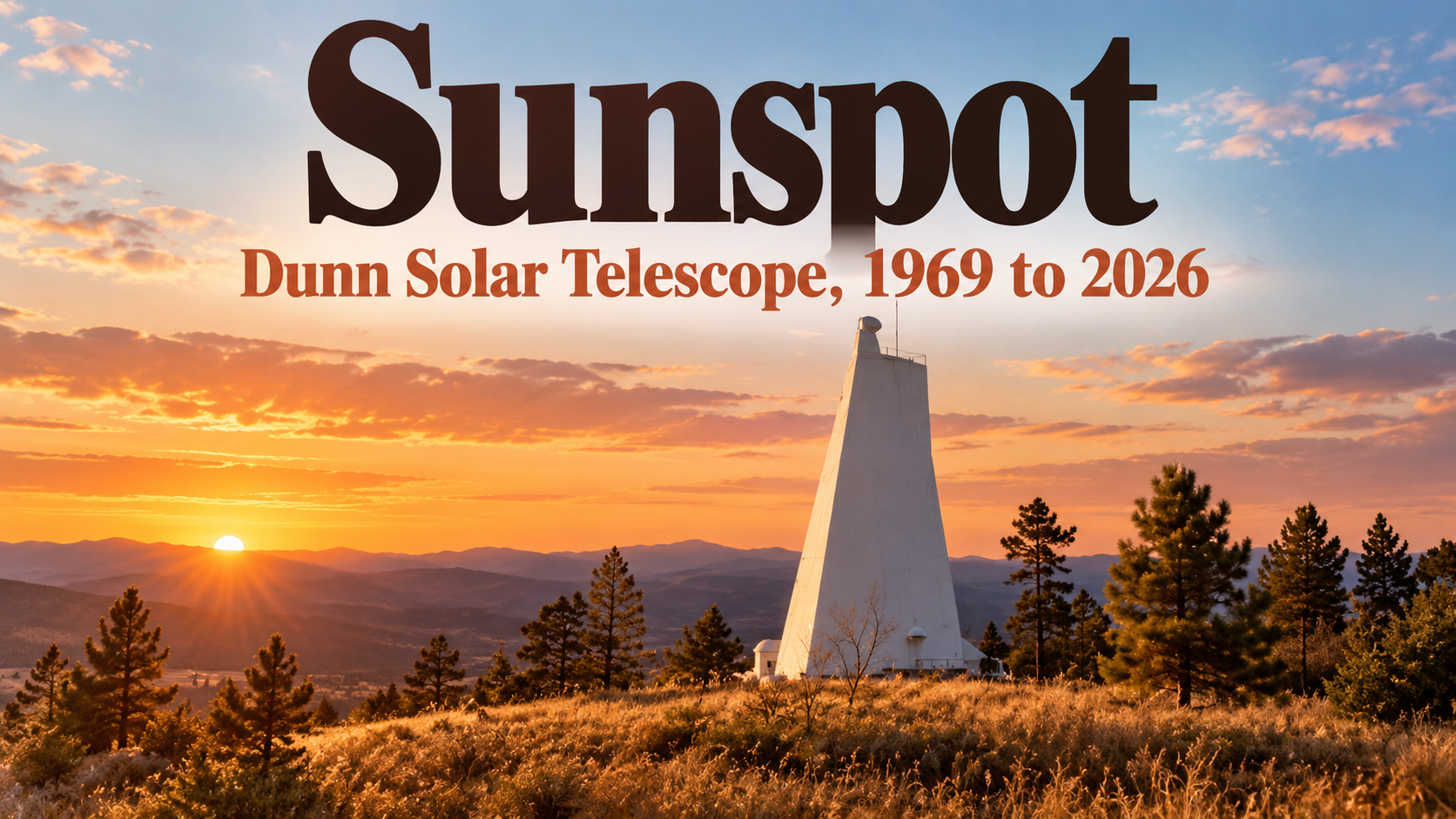
The Dunn Solar Telescope at Sunspot, the tall white tower you can see on the Sacramento Mountains skyline, is being demolished. A mercury leak in early 2026 shut it down, and the National Science Foundation has decided that tearing it down is the safest way to fully clean up the site. Demolition work is scheduled to run through March 2027.
The Dunn has been part of the view from the Tularosa Basin since 1969, so a lot of people here have feelings about this one. Here's what happened and what comes next for Sunspot.
What happened to the Dunn Solar Telescope?
The Dunn used liquid mercury bearings to let its huge vertical telescope rotate smoothly as it tracked the sun. In early January 2026, one of the bearings leaked about 186 pounds of mercury, according to science writer Dave Dooling's reporting for Alamogordo Town News, and the telescope was closed.
The NSF says it finished draining the liquid mercury between July 23 and August 1, 2026, working with the New Mexico Environment Department.
| Date | What happened |
|---|---|
| 1969 | The Dunn Solar Telescope begins operating at Sunspot |
| Early January 2026 | A mercury bearing leaks and the telescope is closed |
| July 23 to August 1, 2026 | The NSF drains the liquid mercury from the telescope |
| August 27, 2026 | The NSF and Forest Service announce demolition is the safest path |
| September 23, 2026 to March 23, 2027 | Demolition contract period, according to Alamogordo Town News |
Why can't the telescope just be cleaned up?
In its August 27 update, the NSF said mercury has bonded to metal surfaces throughout the telescope's interior vacuum structure. Reaching that contamination would mean opening the system and removing the central vacuum tube.
The agency's engineering and hazardous materials contractors concluded that complete demolition is the safest and most efficient way to fully clean up the site. Before demolition, the NSF says it will assess the building for mercury, lead and asbestos with the New Mexico Environment Department, including testing the concrete for mercury vapor.
When will demolition happen?
Alamogordo Town News reported in September that the NSF confirmed a demolition contract of about $10 million, with a work period from September 23, 2026 to March 23, 2027. The same contractor handled the earlier mercury removal.
The NSF's stated goal, under its long-standing agreement with the Forest Service, is to fully clean up the site and leave it as clean as possible.
Update, November 1, 2026: What NSF announced on October 19
On October 19, 2026, the National Science Foundation and the Forest Service posted an updated schedule for Sacramento Peak Observatory. The biggest change: NSF now plans to take down the rest of the observatory's buildings too, in two phases after the telescope. NSF gave its dates in federal fiscal years, so here they are in calendar months.
| NSF timeframe | Calendar months | What happens |
|---|---|---|
| Fiscal 2027, first quarter | October to December 2026 | Scaffolding goes up around the Dunn Solar Telescope, and top-down removal of its concrete structure begins |
| Fiscal 2027, second quarter | January to March 2027 | The tower comes down to ground level and the site is cleaned up; the contract for Phase 1 of the rest of the site is awarded |
| Fiscal 2027, third and fourth quarters | April to September 2027 | Phase 1 removes structures that have been unused for a long time; the Phase 2 contract is awarded and work begins |
| Fiscal 2028, first quarter | October to December 2027 | Phase 2, removal of all other structures, is completed |
NSF says these dates depend on federal contracting and on coordination with the Forest Service and its environmental and regulatory partners, so they could shift. A few other updates:
- No historic listing. In an October 14 letter reported by Alamogordo Town News, NSF said it "does not intend to pursue formal listing of the property on the National Register."
- Objections will still be heard. KOB 4 reported that NSF told attorney Rick St. Hilaire his formal objection will be considered through the dispute resolution process in the site's Programmatic Agreement before any demolition beyond the mercury cleanup.
- Some instruments may be saved. NSF says that where it's feasible, contractors will recover and decontaminate instruments and equipment from inside the telescope for scientific or educational use.
What will happen to Sunspot after the telescope is gone?
Sunspot sits on the Lincoln National Forest, and the Forest Service says it will keep exploring future uses that "create public value" and honor the site's history. The NSF has also committed up to $100,000 for an interpretive exhibit or signs that tell the observatory's story.
Some neighbors are pushing for more. In an interview with Alamogordo Town News, Dave Dooling, a former education officer at Sunspot, said, "The national resource is about to go away, and we'd really like to save it." He described ideas like a science museum or dark-sky tourism using the site's existing homes and buildings. If you'd like to stay in the loop, the Lincoln National Forest invites people to email ReImagineSunspotNM@usda.gov.
What this means for homeowners and people moving here
For Alamogordo homeowners, nothing changes day to day. The NSF and the state are handling the cleanup on federal land up in the mountains.
What it does mean is that a familiar landmark is leaving the skyline, and Sunspot's next chapter is still open. If the Forest Service lands on a public use that draws visitors, that could matter for Cloudcroft and the mountain communities. If you're curious about life up the hill, my neighborhoods guide and moving to Alamogordo guide cover the area, and our region's space history is on full display at the Space Hall of Fame's 50th anniversary.
Frequently Asked Questions
Why is the Dunn Solar Telescope being demolished?
A mercury leak in early 2026 closed the telescope, and mercury has bonded to metal throughout its interior structure. The National Science Foundation decided demolition is the safest way to fully clean up the site.
When will the Dunn Solar Telescope be torn down?
The demolition contract period runs from September 23, 2026 to March 23, 2027, according to Alamogordo Town News. The NSF says it will first assess the building for mercury, lead and asbestos.
How long has the Dunn Solar Telescope been at Sunspot?
The Dunn has operated since 1969. It has been a landmark on the Sacramento Mountains skyline for more than 50 years.
What will happen to the Sunspot site?
The Forest Service says it will explore future public uses for the site after cleanup. The NSF has committed up to $100,000 for an exhibit or signs about the observatory's history.
How can I share ideas for Sunspot's future?
The Lincoln National Forest invites people to email ReImagineSunspotNM@usda.gov. That list will hear about future discussions on the site.
Facts are from the National Science Foundation's August 27, 2026 update and reporting by 2nd Life Media Alamogordo Town News, as of October 4, 2026. Timelines for federal projects can change.